
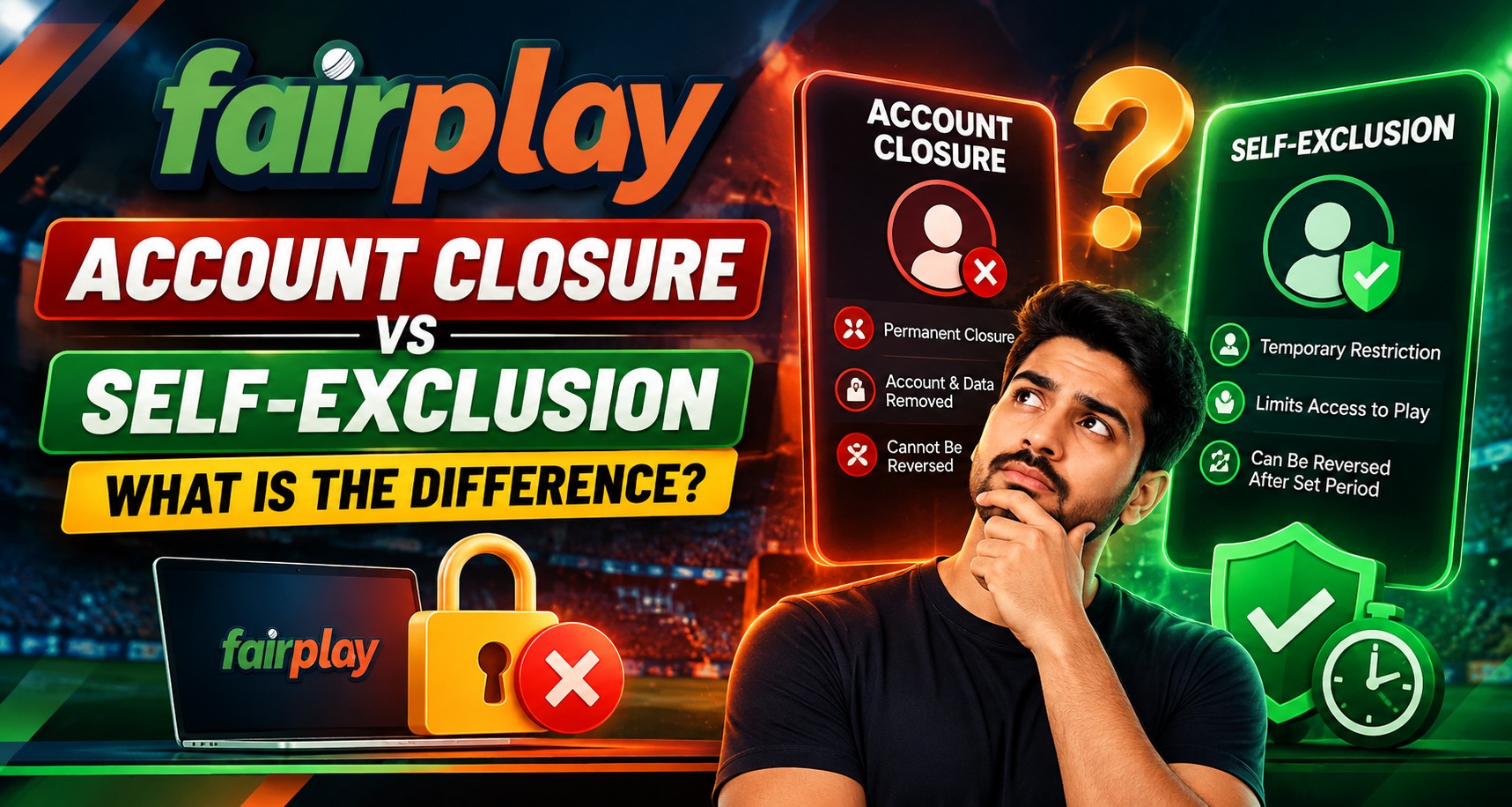
Online account management can involve several options for taking a break from a gaming service. Two terms that are often confused are account closure and self-exclusion. On Fairplay24, understanding the distinction can help users know what each option is designed to do and what may happen after the request is submitted.
Although both options can restrict access, they are not necessarily identical. Account closure is generally an account-management action, while self-exclusion is specifically designed as a responsible-gaming measure. Exact procedures, time periods, reopening conditions, and available controls can vary according to the operator and applicable rules.
What Does Account Closure Mean?
Account closure generally means ending or deactivating a user’s account with a particular service.
A closure may be requested for several ordinary reasons, such as:
- No longer wanting to use the account
- Reducing the number of online accounts
- Taking a general break
- Changing to another service
- Simplifying personal account management
The important point is that ordinary closure does not necessarily represent a formal responsible-gaming restriction.
Depending on the service’s terms, a closed account may potentially be reopened later after appropriate checks.
What Is Self-Exclusion?
Self-exclusion is a formal responsible-gaming tool intended for users who want to prevent themselves from participating for a specified period or, where available, indefinitely.
It can involve stronger restrictions than ordinary account closure.
Depending on the applicable system, self-exclusion may:
- Prevent account access
- Restrict gambling activity
- Stop new gambling activity during the exclusion period
- Remove the user from promotional communications
- Require additional steps before access can be restored
The exact scope depends on the operator and jurisdiction.
Account Closure vs Self-Exclusion
The easiest way to understand the difference is to look at the purpose of each option.
| Account Closure | Self-Exclusion |
| General account-management action | Responsible-gaming measure |
| May be used for various reasons | Intended to restrict gambling activity |
| Reopening may be possible | Reopening may be restricted |
| Usually applies to the specific account | May have broader restrictions depending on the scheme |
| Terms depend on the operator | Often has defined exclusion conditions |
This distinction is important because closing an account does not automatically create the same safeguards as a formal self-exclusion request.
Why the Purpose Matters
Someone closing an account because they no longer need it has a different objective from someone requesting a formal restriction because they want to stop gambling.
For example, a user might close an account because:
- They are changing services
- They no longer use the account
- They want fewer online accounts
Self-exclusion, on the other hand, is specifically connected with controlling or stopping gambling activity.
Understanding the purpose can therefore help users identify the correct account-control option.
Can a Closed Account Be Reopened?
This depends on the operator’s rules.
Some ordinary account closures may be reversible through Customer support or an account-recovery process. A user might have to complete identity verification before access is restored.
Self-exclusion is usually subject to stricter conditions. Depending on the applicable rules, users may have to wait until the selected exclusion period ends before normal access can be restored.
Users should therefore read the relevant terms before requesting either option.
What Happens to Account Funds?
Account balances should be considered separately from account-access status.
Before closing or restricting an account, users should review:
- Available balance
- Pending transactions
- Pending withdrawals
- Active bets or games
- Promotional funds
- Verification requirements
The treatment of funds can vary depending on the operator, transaction status, and applicable rules.
If a user has an unresolved payment issue, keeping transaction references and relevant records can make later communication easier.
What Happens to Promotional Messages?
Self-exclusion can include stronger marketing restrictions than ordinary closure, depending on the applicable rules.
Users who want to reduce promotional communication can also review notification and marketing preferences separately.
For example, after a Fairplay24 Login, users may be able to review available communication or account settings, depending on the platform’s features.
Self-Exclusion Is More Than Simply Logging Out
Logging out of an account does not constitute self-exclusion.
Similarly, deleting an application from a phone does not necessarily close an account or prevent access through another device.
Self-exclusion is a formal request with specific restrictions.
This is why users should not assume that simply:
- Removing an app
- Deleting a browser bookmark
- Logging out
- Uninstalling software
has the same effect as submitting a formal self-exclusion request.
What About the Mobile App?
Mobile access can make account management convenient, but app removal and account restrictions are separate matters.
If a user removes the Fairplay24 App from a device, the underlying account may still exist unless the account itself has been closed or restricted.
Users should therefore check the actual account status rather than relying only on device-level changes.
When Should Users Review the Available Options?
Before submitting a request, users should read the platform’s specific information about:
- Closure
- Self-exclusion
- Account reactivation
- Withdrawal procedures
- Remaining balances
- Promotional communication
- Exclusion duration
This prevents confusion about what a particular request actually accomplishes.
Keeping Confirmation Records
After requesting account closure or self-exclusion, users should keep confirmation details.
Useful records can include:
- Confirmation email
- Support ticket number
- Date of the request
- Account reference
- Details of the restriction
- Stated duration
These records can help if clarification is needed later.
Common Mistakes to Avoid
Users sometimes assume that account closure and self-exclusion are interchangeable.
Other common mistakes include:
- Assuming deleting an app closes the account
- Assuming logging out creates a restriction
- Not checking the exclusion period
- Forgetting about pending transactions
- Not saving confirmation information
- Assuming reopening conditions are identical
Reading the exact terms can prevent these misunderstandings.
Responsible Account Management
Account controls are only one part of responsible gaming. Users should also consider personal limits, breaks, spending controls, and notification settings.
If gambling is becoming difficult to control or is causing financial or personal problems, seeking independent support can be an important additional step.
For users reviewing Fairplay24 Com information, understanding the difference between ordinary closure and formal self-exclusion can make account-management decisions clearer.
Conclusion
Account closure and self-exclusion may both restrict access, but they serve different purposes. Account closure is generally a standard account-management action, while self-exclusion is specifically designed as a responsible-gaming restriction.
The exact duration, reopening process, treatment of funds, marketing restrictions, and scope can vary by operator and jurisdiction. Users should therefore review the applicable terms and keep confirmation records after submitting a request.
FAQs
Is account closure the same as self-exclusion?
No. Account closure is generally a standard account-management action, while self-exclusion is a formal responsible-gaming restriction.
Can a closed account be reopened?
It may be possible depending on the operator’s rules. Additional verification may be required.
Can self-exclusion be reversed immediately?
Usually, self-exclusion has stricter reopening conditions than ordinary closure. The applicable duration and reactivation rules depend on the operator and jurisdiction.
Does uninstalling the app count as self-exclusion?
No. Removing an app from a device does not necessarily close or restrict the underlying account.
What happens to money in an account after closure?
The treatment of remaining funds depends on the operator’s procedures, pending transactions, verification requirements, and applicable rules.
Does self-exclusion stop promotional messages?
Self-exclusion commonly involves restrictions on gambling-related marketing, but the exact process depends on the applicable operator and regulatory framework.
Should I keep confirmation of my closure or self-exclusion request?
Yes. Keeping the confirmation, reference number, date, and stated conditions can be useful if you need to clarify the account status later.